Marja-Leena Rathje

on printworks and other passions
  • About
  • Gallery
  • Contact
  • Exhibitions
  • Home

PRINTWORKS

  • Hands
  • Fragments
  • Arkeo
  • Silent Messengers
  • Nexus
  • Paths
  • Meta-morphosis
  • Dreams
  • Veils Suite
  • Older Works

PHOTOWORKS

  • Found Objects
  • Human
  • Nature
  • Rocks
  • Textures
  • Urban

RSS Feeds

  • RSS - Posts

Blog

Search Results

← Previous Entries
Next Entries →
by Marja-Leena

at the Vancouver Art Gallery

8:35 pm in Art Exhibitions by Marja-Leena

This past Thursday evening Erika and I had a date at the Vancouver Art Gallery. We were there to see several exhibitions, two of which finished today.

1. The biggest attraction was the Monet to Dalí: Modern Masters from the Cleveland Museum of Art

sm_monet_fantin_marie_yolande.jpg
Henri Fantin-Latour
Marie-Yolande de Fitz-James, 1867
oil on fabric
Gift of Lewis C. Williams
© The Cleveland Museum of Art

Monet to Dalí represents the most comprehensive showing of European painting and sculpture in Vancouver in more than half a century. Drawn from the superb collections of the Cleveland Museum of Art, the exhibition consists of more than 80 paintings, drawings and sculpture that demonstrate key examples from the European modernist movement. Organized into four groupings, this exhibition covers a century of art making from 1864 to 1964 and showcases important work by the major Impressionists, Post-Impressionists, early modern sculptors and avant-garde artists interested in Dadaism, Cubism and Surrealism. Most notably, the exhibition includes key works by Manet, Monet, Cézanne, van Gogh, Rodin, Picasso, Dalí and other renowned artists. Together, the works in this stellar collection illuminate the breadth of creativity in one of the most extraordinary epochs in the history of Western art.

Many of the works were wonderful to see, but very difficult and frustrating because of the crowds that would create bottlenecks around the most famous pieces. Even though entry numbers were controlled, there were far too many people in there for decent viewing. I should have gone during a morning rather than an evening of the last week.

Here is more information and a few images of some of the works.

2. On the second floor were the massive works by an artist new to me. Very impressive – he must have an airport hangar for a studio!

House of Oracles: A Huang Yong Ping Retrospective

img_house.jpg
Huang Yong Ping
11 June 2002 – The Nightmare of George V, 2002
concrete, reinforced steel, animal skins, paint, fabric cushion, plastic, rope, wood, cane seat
Collection of the artist
Installation view, Walker Art Center, Minneapolis Photo: Gene Pittman

House of Oracles is the first retrospective of Huang Yong Ping, one of the most influential contemporary Chinese artists working today. Showcasing paintings, drawings and sculptural installations that evoke the fun house, diorama and menagerie, the exhibition celebrates an artist whose work elegantly traverses the divide between East and West, tradition and the avant-garde.

Renowned for his extravagant large-scale installations, the exhibition will feature more than forty works, including a monumental sculpture that positions a snarling tiger atop an elephant, a 100-foot long wooden python skeleton and the re-creation of a Beaux Arts-style bank using 40,000 pounds of sand. In addition to these spectacular installations, the exhibition includes significant early works from the artist’s career, reflecting his interest in ideas on chance, creative process and divination.

Born in Fujian Province, China in 1954, Huang Yong Ping formed the Xiamen Dada group in 1986. One of the most radical of the Chinese avant-garde artists’ groups active at the time, members were inspired by their interest in the work of Marcel Duchamp, Dada and the role of chance in art. The group’s subsequent activity, particularly Huang Yong Ping’s artistic production, are often considered among the first post-modern works in Chinese art and are credited for opening new channels for other Chinese artists, who until that time were predominantly influenced by the conventions of Socialist Realism.

Since his participation in the seminal exhibition Magiciens de la Terre at the Pompidou Centre in 1989, Huang Yong Ping has lived and worked in Paris and exhibited extensively around the world.

More information

3. On the third floor is Andrea Zittel: Critical Space, still on until September 30th

The first comprehensive North American exhibition to survey her work, Andrea Zittel: Critical Space will present the American artist’s particular interdisciplinary way of working as a designer, engineer, consultant and advocate using the corporate identity “A-Z Administrative Services. For the last decade, Zittel has investigated fundamental aspects of contemporary life in Western societies, notably increased mobility, security, comfort and consumerist packaging. The exhibition focuses on the experimental character of the artist’s signature objects, equipment and projects. It highlights models for and locations of alternative living, including her well known customized trailer-home Escape Vehicles, Uniforms and “units” she has developed for specialized living, working and research.

More information and images.

4. The top floor has Emily Carr and the Group of Seven, mostly the VAG’s collection and some private loans. We did not have time for this one but I’ve seen and enjoyed many of them numerous times over the years.

The three very different exhibitions, all very powerful and satisfying in varying ways, made for a great night of art viewing! I must say that the VAG has been bringing in some very good shows the past few years. No cameras are allowed at the VAG, so I’m sorry not to have photos to show here.

5 Comments »

by Marja-Leena

dying languages

11:22 am in Culture, Ethnicity, History, Linguistics by Marja-Leena

languagehotspots.jpg
Image credit: Enduring Voices Project

Finnish was my first language. I was five years old when my family emigrated to Canada. Arriving in Winnipeg, I was promptly placed in school, not knowing a word of English. Now that was language immersion! I don’t remember much of those early scary days. I was already reading Finnish and we continued to speak Finnish at home. I learned English quickly enough as children do, but my parents’ English was never perfect. LIke many working class immigrants, they were too busy working hard to survive to take more than a couple of basic language classes. Some immigrant parents, wishing to learn English through their children, did not allow their native languages to be spoken so some of my friends lost most of their mother tongue. I’m sure this was typical of many immigrant experiences in North America and other parts. These days, I’m sad that my Finnish is not a strong as English from lack of everyday practice since my parents are no longer with us.

Perhaps because of that, I’ve developed strong feelings about language being part of a person’s identity and connection with his or her roots and culture. So whenever I read about how many languages are dying around the world, I feel sorrow at the world’s loss of so many cultures.

Yesterday’s Vancouver Sun has one such story, B.C.’s native languages rapidly dying: linguists

Indigenous languages are dying off at an alarming rate in British Columbia, prompting linguists to include the province on a list of the five worst global “hot spots” for language extinction. Most fluent aboriginal speakers are aged 60 or older, and their languages will be lost forever when the last speaker dies, said David Harrison, co-director of the Enduring Voices project, which seeks to document and revitalize languages slipping towards oblivion.

and…

Much of the blame for language loss can be tied to residential schools, UBC linguistics Prof. Suzanne Gessner said. For decades, children were taken away from their families during the school year and educated in English. A compensation package designed to address the wrongs of residential schools did nothing to revitalize languages, she said — and last November, the federal government cut $160 million in funding for aboriginal languages.

Further links:
Enduring Voices Project
Living Tongues Institute for Endangered Languages
Why preserve languages? – my post of spring 2004

6 Comments »

by Marja-Leena

BC Day long weekend

3:34 pm in Being an Artist, Canada and BC by Marja-Leena

SunsetNrKamloops.jpg

Our long weekend was a wonderful, busy and mostly family-oriented one. First, a sister-in-law arrived from Idaho on Friday. It’s been almost a year since we last saw her.

Saturday morning a caravan of three cars of family drove up to the hot and dry high country area of Kamloops and east. Our eldest daughter and partner held a huge party for their numerous friends and immediate family. Their acreage turned into a campground with many campers and tents scattered about. They had renovated the old barn on their property and transformed the interior with whitewash and twinkling lights over numerous tables for the diners and the fantastic buffet of food. What a party, wonderful fun for all ages from babies, children, teenagers, young singles, couples and parents and a few of us elders!

goats_n_girls.jpg

On Sunday morning husband, youngest daughter and I drove to Salmon Arm, over an hour east from our motel in Kamloops to visit my brother and two of his sons. Lovely to see them again! Then back to the party – with a trip to the swimming hole on the Thompson River to cool off. Later the children (even some of us adults!) loved a visit with the neighbour’s goats. Then more wonderful food!

Yesterday, the BC Day holiday, we made our way home, tired from a lot of driving but happy. Great to sleep in our own bed again. Sister-in-law took a side trip to visit a friend in Vernon and is returning here later this afternoon for a few more days’ visit. So, we’re keeping busy, busy with family!

10 Comments »

by Marja-Leena

oil spill

4:20 pm in Canada and BC, Current Events, Environment by Marja-Leena

For over a week now, we’ve been appalled over an environmental disaster that occurred in the Greater Vancouver area. Last Tuesday, July 24th, there was a huge oil spill in Burnaby, a suburb just east of Vancouver, on the south side of Burrard Inlet. Contractors doing sewer work hit a pipeline and a 12 meter geyser of crude oil sprayed roads, cars and homes and spilled into the ocean waters nearby. This is part of Kinder Morgan Canada’s TransMountain Pipeline system, carrying crude oil from a pipeline terminal at the foot of Burnaby Mountain to a tanker-loading facility on the Inlet. (Can you see the oil tanks in the top photo below? – the disaster happened in the area to the left of them.)

Naturally this raised concerns for the health impacts on the residents and homes and environment in the immediate vicinity. Numerous concerns about the industry have also come up again for all of BC and its coastal waters.

Living on the other side of Burrard Inlet not far from the spill, we were worried about reports that the oil spill spread to North Shore beaches and parks, affecting marine life, First Nations’ clam beds, and the Maplewood Mud Flats, a local saltmarsh and bird sanctuary.

CatesBeachClosed.jpg

CanadaGeeseCates.jpg

Catesgeese.jpg

Last Friday evening right after sunset, we went on one of our regular walks to Cates Park, situated right across the water from the disaster area. We checked out the beaches and its families of Canada geese. Though there was yellow tape tied across the beaches and posted warnings to stay off, our untrained eyes could not spot any evidence of oil. Looked like the cleanup crews had done a good job here and will continue to be busy for a while in many spots on this coast. Several families in Burnaby in the meantime are still dealing with the damage to their homes and gardens – what a terrifying experience. When it comes this close to home…

DuskCatesBeach.jpg

12 Comments »

by Marja-Leena

connections

12:50 pm in Being an Artist, Blogging by Marja-Leena

springflowers.jpg

I have often mentioned that finding connections and being inspired by them is very much a part of the way I think and find ideas for my art work. One of my print series is even called Nexus, which mean connections. Blogging for me is about connections too, about inspirations given and received in this wonderful moving web that covers the world.

These thoughts have re-emerged to the front right now as I’ve been honoured and very awed by several blog-friends who’ve found connections and inspirations from a couple of my recent posts.

Dave wrote a fabulous poem.

Mouse in France wrote some great prose, both inspired by my post about hands in cave art.

Olga wrote both prose and a great poem about her thoughts on connections, inspired in part by an art piece of mine.

Venus de Willendorf was the subject of one interesting blogpost by Finnish blogger “hanhensulka”, living in Brussels, and he responded to my comment with a post linking to my Venus works, and the hands post as well!

Thank you, friends, for this wonderful web of inspiring connections!

On the home front, we have been having a week of mostly sunny weather and spring is definitely here at last. I’ve been busy preparing for friends arriving this afternoon for a short stay this weekend (connections of another kind!). Dessert just came out of the oven, husband is out picking up a fresh salmon for the barbeque, and I’m having a short break catching up a little with blog reading and writing. Have a great weekend, everyone!
———-
Addendum: April 2nd. Though I don’t take horoscopes seriously, I could not resist a chuckle over today’s very weird one for this Aquarius, in our local newspaper:

“You’re making a connection, a link between your small mind and your higher mind. You may feel like an alien in a bubble, but you’re no stranger to being strange. Stay in touch with your earthly relations.”

7 Comments »

by Marja-Leena

Kalevala and Vietnam

8:14 pm in Books, Culture, Finland, Estonia & Finno-Ugric, Folk Legends & Myths by Marja-Leena

4x4_arkisto2.jpg

I know that the Finnish national epic the Kalevala is read around the world, translated as it is into 61 languages. So I’ve been quite intrigued to read a fascinating story about two Vietnamese women and their involvement with the Kalevala and how it inspired a project to compile a Vietnamese national epic with help from a Finnish foundation. Here are some excerpts:

The home of artist Dang Thu Huong in Hanoi is an austere one-room apartment with nothing unnecessary in it. The eye rapidly focuses on paintings leaning against a wall. They depict Finnish barns and national costumes. Huong has made illustrations for the Kanteletar, the companion work to the national epic poem, the Kalevala, which has been translated into Vietnamese by Bui Viet Hoa. The next effort of the women is to compile and illustrate Vietnam’s first national epic by the end of next year. The two are getting support from the Juminkeko Foundation, which specialises in the Kalevala. It has received development cooperation funding for the project from the Finnish Ministry for Foreign Affairs.

Lönnrot wrote the Kalevala based on folk poetry from the oral tradition that he compiled during travels in Russian Karelia in the 19th century. Hoa translated the epic into Vietnamese in 1994. [Bui Viet Hoa ] has been referred to as “Vietnam’s Elias Lönnrot”. Lönnrot wrote the Kalevala based on folk poetry from the oral tradition that he compiled during travels in Russian Karelia in the 19th century. Hoa translated the epic into Vietnamese in 1994.

Vietnam has 54 ethnic groups with dozens of oral miniature epics. Hoa uses them as a basis for her own work, which is to unite the nation. The most challenging job is to compile a unified story out of very many different epics. Hoa solves the problem by dividing the book into two parts – the world of myths, and the world of heroes. Like the Kalevala, the Vietnamese myths describe the origin of the world. In both epics, everything begins with a bird’s egg. In Hoa’s book, there is a separate story about how water-buffalo and rice came into being.

Like Lönnrot, Hoa has travelled among the people to collect her stories. Accompanying her was the third worker in the project, Hoa’s husband, linguistic researcher Vo Xuan Que. The two have gone into Vietnamese villages and asked men and women of different ages to sing for them.

(Photo from Juminkeko archives)
Related links:
the Kalevala
Epics of the world
Juminkeko Foundation
about the word “Juminkeko”

*****************************
UPDATE March 14th: Bill’s comment below has prompted me to do another search for an online English translation of the Kalevala. The Finnish Literature Society did have a full translation on their site three years ago when I’d first mentioned the Kalevala on this blog, but now offers only the original Finnish, and a synopsis in English.

Checking out Bill’s leads, I see that Wikipedia has a very good page on the Kalevala, including a short synopsis as well, and links to translations. The translations are all by John Martin Crawford and I am not impressed with this version.

However, there are many translations in print. After some research last year, I found and bought this translation by Eino Friberg. It is excellent, capturing the wonderful oral quality of the Finnish original. I recommend it highly to any interested readers.

On a side note, the Wikipedia entry excites me because of the illustrations of some of the famous paintings based on the Kalevala by my favourite Finnish artist of the late 19th-early 20th century Akseli Gallen-Kallela. But there’s another subject for a very long blog post one day!

14 Comments »

by Marja-Leena

earth day

12:02 am in Current Events, Environment by Marja-Leena

CatesTree.jpg

Happy Earth Day, every day! Do you realize that the environmental movement has been around for many decades? It has had its ups and downs in support, but it seems to me that this year there is a greater interest and a sense of urgency amongst more people than ever before. Thanks in part must go to Al Gore’s film An Inconvenient Truth, which, by the way, is quite powerful though it doesn’t cover all the issues of concern – a must see if you haven’t already seen it.

Earth Day is the brainchild of Earth Day Network, an international organization, which was founded in 1970. In 1971 Greenpeace was founded in Vancouver (Canada).

Vancouver is also the birthplace and home of David T. Suzuki, an award-winning scientist, environmentalist and broadcaster, recognized as a world leader in sustainable ecology for over 30 years. He heads the David Suzuki Foundation. His message is being heard more and more as he’s travelled Canada speaking with people and getting the message to leaders in Ottawa.

Besides the above resource rich websites, there are a number of interesting and practical blogs that offer some help in thinking about and achieving a smaller ecological footprint. Here are just a few that I’ve been reading that you might also enjoy:

Treehugger
Worsted Witch
Green Living Tips
Grist (this via Frogs and Ravens, who has a list of even more resources).

What are your favourite sites that inspire you to make changes in the way you live your life or perhaps even be an activist?

9 Comments »

by Marja-Leena

a collaboration

9:59 am in Being an Artist, Other artists, Silent Messengers by Marja-Leena

RathjeSMd%27Amico%232.jpg
Connecting with D’Amico #2

Yippee! Our collaborative project In Its Four Voices – Silent Messengers: Connecting with D’Amico #2 has been published on Qarrtsiluni, the online literary and visual art zine! Go see and LISTEN to it! Then come back….

I must tell you the story behind this international collaboration. First about the image. Artist Karen D’Amico** of London, UK, and I met and corresponded through our respective artist blogs. She mailed me about a dozen close-up photographs of rocks that she had taken, and offered these to use in my work as I wished. I chose five of them to create the prints called Silent Messengers: Connecting with D’Amico #1-5. Thus it became ‘a borderless collaboration of sorts’, as Karen commented.

Sometime earlier this year, blog friend and prolific writer and poet Tom Montag of Wisconsin, USA, expressed an interest in writing a poem inspired by one of my Silent Messenger pieces. Tom wrote a fairly long and thrilling piece based on his choice, Connecting with D’Amico #2.

I am still astounded and awed that my work inspired this. In turn, I felt excited and inspired to find a way to make this into some kind of performance piece. With no experience in this and with the three of us in three different countries, a voice recording seemed the best possibility.

Around the same time Qarrtsiluni’s editors decided that the theme for March and April would be Ekphrasis – ‘poetry in dialogue with visual art’. Perfect…. except for the restriction to far fewer lines than Tom’s poem has. We checked with the editors to see if they would consider an audio file. Yes, they replied and so, we pushed on.

I roped in my clever daughter Erika who had some experience with digital music recording. The challenge was to find four readers and capture their voices into one recording. My husband got drawn into this, a bit reluctantly, heh, to read the first voice. As Karen was too busy to participate at this time, Erika took her place as the second voice. And I read the third voice, that of the artist/marker, of course. Recording our voices here at home was physically easy enough, but Tom is in Wisconsin, you know. After a few trials, the best recording of Tom’s reading of the fourth voice was over his phone into our computer with the aid of some special software and Skype (thanks to my husband’s expertise here). Then Erika did all the intricate editing work on all the voices using Apple’s Garage Band, not exactly the most professional program but giving us reasonably good results we think.

As Tom said, this is ‘a collaboration of a collaboration across three countries and three media’. This project has been an exciting new venture for me, and for all of us, and I’m so thrilled with it. A huge thank you to Tom for the fabulous poem and his reading, to Karen again for the photos that inspired my work, to my husband for his voice and technical help, and to Erika for her voice, advice and skillful editing work! And a big thank you to all the editors of Qarrtsiluni for their excellent editing suggestions and for publishing this.

We hope you like it…
(Tom is away on vacation right now, but I hope he will write a few words about his poem on his blog when he gets back. I’ll update with the link here when it happens.)

** Reedited March 15th, 2013 during a blog tidy-up: Karen has not been at this blog address for some years, so link has been removed. I have now quite accidentally found her new eponymous website: Karen Ay

9 Comments »

by Marja-Leena

a year ago, May 14th

6:07 pm in Travel by Marja-Leena

I ran out of time and steam to write much about the last week of our Europe trip a year ago, and since I’m rereading my paper travel diary almost daily, I thought I’d put in a few snippets from it to fill in the gaps, when I get the chance.

We said tearful goodbyes to our family in London after a lovely two and half week stay with them. We were picked up by a taxi service and taken to St. Pancras station which was very nice, like an airport with efficient and friendly service. Way too early as we were, we wandered about then sat down for coffee at a well-known American chain and enjoyed a truly piping hot cuppa with full cream, something that seemed rare in most places in England.

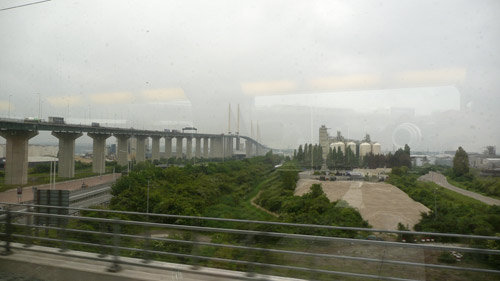
UKFromTrain.jpg
a view from the train still in the UK

The Eurostar train was very pleasant, smooth-riding and fast, offering nice glimpses of the English countryside, and even another ‘white horse’ on a hillside, and a few tunnels along the way. We did not even realize when we were in France (I’d briefly dozed while husband was reading) until I noticed an IKEA Maison and the highways with drivers on the ‘right’ side! The countryside did not look that different.

Gare du Nord station in Paris was not as nice as St. Pancras for parts of it were under reconstruction. It was very busy there while we waited anxiously for our driver who was late to pick us up and take us to the apartment that we’d rented for the week. He did arrive and was most apologetic due to the rush hour. First impressions from the back of the car were of polite drivers but many aggressive motorcyclists, including women, and regular cyclists on bicycle paths that were part of wide sidewalks rather than the busy road. People seemed very relaxed even in the rush hour.

We picked up our keys and were then driven down a very narrow lane, more of a pedestrian lane, to our building in Le Marais district close to the Seine River. The elevator was not working so we had quite a trek up the winding stairs with luggage up to the third floor, thanks to the help of the driver. The apartment, as we expected, was modest but clean and facing an inner courtyard so fairly quiet. Lovely big bed after that narrow hideway at daughter’s and a real shower in the bathroom!

OurStreetMarais.jpg
our street in Le Marais

After relaxing for a while we went out to explore the area. Two small supermarkets below us and a health food store around the corner, many cafes and patisseries around. Hôtel de Ville (city hall) on a big square with a carousel and fountains, beyond the river and a bridge to Île de la Cité. Lots of people out enjoying the evening. Nice. A light supper at a nearby cafe before we wandered back “home”.

HoteldeVilleSquare.jpg
Hôtel de Ville square at dusk

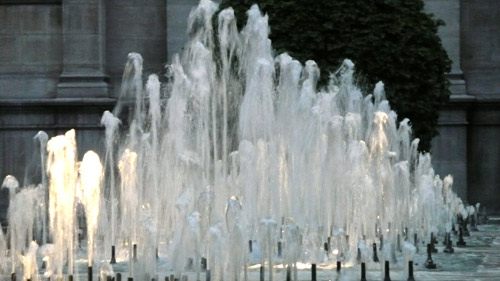
FountainHoteldeVille.jpg
the fountains by Hôtel de Ville square

Wow. We are really in Paris!

8 Comments »

by Marja-Leena

forest in our backyard

12:02 am in Being an Artist, Blogging, Canada and BC, Photography by Marja-Leena

SeymourForest3.jpg

About two weeks ago, I made a long overdue first visit with some of my family (who’d been there before) to the very popular, though awkwardly named Lower Seymour Conservation Reserve located in the North Shore mountains behind us, right in Vancouver’s backyard. I don’t know why I’d waited so long. There are numerous trails to explore through these beautiful forests so I look forward to visiting many more times. The only problem was that I spent more time taking photos than walking so I may have to leave the camera home if I want to get a workout.

Anyway, I promised more photos from that first walk, and being on things arboreal, it’s just in time for this month’s Festival of the Trees, being hosted at the beautiful trees, if you please.The deadline for submissions is September 28th, so there’s still time to participate.

SeymourForest2.jpg

One of the things I love about the Pacific Northwest is our forests and the way the tall trees create a magestic canopy overhead. Here and there were orange and rust coloured sculptural forms standing out from the darker green background of cedar and hemlock, often highlit by a perfectly placed beam of sunlight, like a spotlight on the star of the stage. These still brilliant skeletons look like they may be the remains of giants felled by last winter’s huge windstorms. Here was beauty even in the early stages of decay. At the same time we were appreciative that they were still full of life giving nutrients for future trees, birds, bug-eating creatures and the ecology of the forest floor – a circle of life.

cone_n_butterfly.jpg

14 Comments »

← Previous Entries
Next Entries →

RECENTLY

  • New Year’s Eve 2016
  • Season’s Greetings
  • November already
  • this summer’s moth
  • Michiko Suzuki: Hope Chests
  • hand with Easter eggs
  • for Women’s Day

THEMES

  • Anthropology
  • Art Exhibitions
  • Art Institute (Printmaking)
  • Being an Artist
  • Blogging
  • Books
  • Canada and BC
  • Care of Art Works
  • Concepts
  • Culture
  • Current Events
  • Digital printmaking
  • Drawings
  • Environment
  • Ethnicity
  • Films
  • Finland, Estonia & Finno-Ugric
  • Folk Legends & Myths
  • History
  • Home
  • Linguistics
  • Modern Rock Art
  • Music
  • Neat stuff
  • Other artists
  • Photography
  • Print Triennials
  • Printmaking
  • Rock Art & Archaeology
  • Tools and technology
  • Travel

© Marja-Leena Rathje 2004-2026