Marja-Leena Rathje

on printworks and other passions
  • About
  • Gallery
  • Contact
  • Exhibitions
  • Home

PRINTWORKS

  • Hands
  • Fragments
  • Arkeo
  • Silent Messengers
  • Nexus
  • Paths
  • Meta-morphosis
  • Dreams
  • Veils Suite
  • Older Works

PHOTOWORKS

  • Found Objects
  • Human
  • Nature
  • Rocks
  • Textures
  • Urban

RSS Feeds

  • RSS - Posts

Blog

Search Results

← Previous Entries
Next Entries →
by Marja-Leena

Finland Diary

12:23 pm in Finland, Estonia & Finno-Ugric by Marja-Leena

Wow, did I receive a lovely surprise on this morning’s check on ionarts. In Blogging Finland, Charles Downey wrote:

Thanks to The Cranky Professor, I learned about one of the Washington Post blogs, Robert G. Kaiser’s Finland Diary, for which the blogger and a photographer are traveling around Finland, “the world’s most interesting country that Americans know least about.” Given our admiration for the musical life of the Finns, I have a feeling it will become a regular read. Does Marja-Leena know about it yet?

I’ve spent the last hour (I’m supposed to be working!) reading the “diary”, really amazed and proud of my birth country’s success. Most of it is not really new to me, it’s the details that really fascinate me. It’s interesting also to hear about places I know such as Kuopio which is in my “home” province in beautiful eastern Finland, and the lively university and arts town of Jyv&#228skyl&#228, and of course Helsinki.

That city mayors are hired, not elected, into permanent positions is news to me. Government by consensus, even in coalition governments, we know about and often bring up in discussions here in Canada, with our presently embattled federal minority government, and in British Columbia where we’ve just had a referendum on changing to a proportional representation voting system (which exists in Finland).

Finland’s high taxes are often brought up but we’ve found from personal discussions with relatives that they are really no more than what we pay in Canada, when you add all our various taxes and user fees, but they receive more for their money. Finns generally see taxes as a fair price to pay for a society that provides equal opportunities, and because everyone benefits directly from our public services. Everyone has been educated in public schools and universities. Everyone has used the public health services. These aren’t just services for the poor. If you don’t allow your democratically-elected government to tax the economy to provide equal opportunities in life for everyone, no one else can do it.  But comparing tax bites as a percentage of GDP is misleading. To compare yourselves to Finland, Americans should add to the 25% you pay in taxes all the costs of health insurance and health care, higher education, savings for pensions and so on–in other words, all the expenses that Finns don’t have to pay, once they’ve paid their taxes.

Finland’s excellent education system has received a lot of attention. I’m pleased to have confirmation of a suspicion that credit goes to the high status given to the vocation of teaching. Teachers are required to have a great deal more education than generally here in North America.

Many thanks, Charles, for sharing this link – I do look forward to a “regular read” of Finland Diary.

UPDATE: The word is out in Finland at Finnish blog Pinseri!
Comments Off on Finland Diary

by Marja-Leena

Father’s Day

11:06 am in Culture by Marja-Leena

Happy Father’s Day to all Dads everywhere! We enjoyed revisiting last year’s wonderful poem/card by our daughters to their Dad. This year’s celebration is quiet with only one daughter home, one living several hours drive away, and the third out of the country on vacation. We are also remembering and missing our own fathers, gone many years now.

According to Wikipedia’s history of Father’s Day, it became an official day in USA in 1972. I notice also that Father’s Day is not celebrated the third Sunday of June everywhere, for instance in Finland it is in November.

1 Comment »

by Marja-Leena

Pekka Kivikäs

12:01 am in Books, Finland, Estonia & Finno-Ugric, History, Rock Art & Archaeology by Marja-Leena

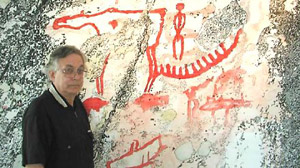
kivikas.jpg

As my readers know, I’m nuts about prehistoric art, particularly that of northern Europe. One site that I check periodically is Arkeo.net**, a Finnish portal for archaeology fans. Recently I spotted a notice about some new books (PDF) that have come out.

I’m particularly keen on the two books by Pekka Kivikäs. “Rocks, Landscapes and Rock Paintings”, written in both English and Finnish, is about Finland’s pictographs, based on his many years of research. The other book “Ruotsin Pyyntikulttuurin Kalliokuvat Suomalaisin Silmin” (Sweden’s Prehistoric Rock Paintings Through a Finn’s Eyes), is based on the author’s 12 years of visits to Swedish sites. I’ve been hoping to get my hands on some of his books which have gone out of print, so I’ve eagerly ordered these two new ones from Akateeminen Kirjakauppa, a major bookstore in Helsinki which takes online orders and credit card payment. I can hardly wait.

Kivikäs was the subject of a very early post I wrote when starting this blog. I’ll repeat this quote:

The art teacher Pekka Kivikäs has become well-known for his work as an active documenter and publisher of Finnish rock paintings… the book is aimed at the wide circle of readers interested in the ancient culture of Finno-Ugric regions…Kivikäs considers rock art the silent message of man from behind the thousands of years….

Rereading this now, I’m struck by “silent message”, considering that my current working print series is titled “Silent Messengers”!

In 1999, Kivikäs’ home city of Jyväskylä honoured him and his life’s work by establishing the Kivikäs Prehistoric Centre. It features his immense research material of mostly Finland’s prehistoric rock paintings and continues the work of research, documentation, education and tours to the rock art sites. If I had known of this centre when visiting Jyväskylä in 2000, I sure would have gone there. Next time.

Unfortunately the website is only in Finnish because there’s some interesting reading about the history of the place, but have a look at the photos. My Finnish readers may enjoy it. The Centre is located on a historic 1763 property in the newer Kuokkola Manor, which was built in 1904 for the Swedish-Finnish businessman Julius Johnson.

A bit off the subject, I found it fascinating that the Manor was designed by a woman architect who was a classmate of the famous Eliel Saarinen amongst others. Wivi Lönn (1872-1966) (PDF in English) was the first Finnish woman to start an architectural agency. She gained the qualifications of architect in the 1890s during an era when women were only allowed entry into construction education programmes by dispensation. She had a long and successful career despite some overshadowing by male colleagues. Her last creation was at the age of 78, and she died at the age of 94.

UPDATE: In the comments below, Blogisisko pointed to an article in English about women architects in Finland in the Early 20th Century**, in which Wivi Lönn is included. She’s also written a post about her, with some photos coming soon.

Virtual Finland** is a wonderful resource on everything about Finland and I read it frequently. This time I did not delve into it, as I was really focusing on Pekka Kivikäs. Funny how easily one gets off the subject, especially when one finds such an interesting tidbit.

**the Virtual Finland and Arkeo links no longer exist, I’m sad to note.

3 Comments »

by Marja-Leena

Sunday in Vancouver

12:09 am in Art Exhibitions, Being an Artist, Finland, Estonia & Finno-Ugric by Marja-Leena

DeepCove.jpg

A gorgeous sunny warm day yesterday tempted us outside to explore. We headed to Deep Cove with walking shoes, a backpack with water, a snack of nuts and the camera. The “Cove” was pleasantly crowded with people enjoying the boating (sail, motor, kayak and canoe), the waterfront parks, the village with its little shops and cafes.

We poked around and then went into the Seymour Art Gallery to see the current exhibition “Lelam” (Coast Salish for “friend”) of First Nations work. We liked most the various objects made of leather, and the furniture made of wood and steel incorporating native designs. We were quite fascinated by the photos of the method of preparing the cedar bark for weaving their fine traditional cedar bark hats.

This reminded us of how similarly the Finns prepared birch bark for their traditional weaving into baskets, shoes, belts, even hats. There was an extensive display of birch bark works and photos of the technique in the excellent Craft Museum of Finland that we visited a few years ago – I wish it was on their website. We also met the retired husband of one of my cousins who made the most marvellous hats of many styles, but would not sell them, for he used them as examples for his demonstrations in his teaching of the craft. Long ago. a maternal great-uncle made a beautiful basket and pair of shoes (usable but kept for decoration only) for my mother, who later gave them to me because I loved them so much, and I still treasure them and display them proudly.

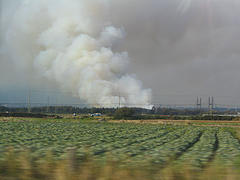
Oh, I’ve wandered off the subject of our day! Some time after we got home from our outing, we smelled acrid wood smoke and noticed the air was very hazy all around. Where’s the fire? We turned on the TV for the early evening news, to learn about a large fire in Burns Bog, south of Vancouver. The winds were spreading the smoke all over the Lower Mainland. This could last a long time as the peat burns deep. I happened to come across Boris Mann’s post and photo of ithe fire at Urban Vancouver, which I’ve captured below. Our pleasant day of fresh air, exercise, sightseeing and art ended with no fresh air and a stuffy closed house to sleep in.

burnsbog.jpgnews report on the Burns Bog fire

3 Comments »

by Marja-Leena

prints vs reproductions, again

9:19 pm in Being an Artist, Digital printmaking, Printmaking by Marja-Leena

This really got my attention: Anna Conti’s post Giclée can of worms. Go read this excellent and thought-provoking article first, then come back.

Indeed! Giclée is a fancy name for high-end inkjet printing, and was very important in its early days for its archival quality, meaning that the inks are acid-free and UV resistant and the papers are also acid free. Archival inks and papers are readily available now, even in some of the newer consumer inkjet printers. (If you are printing valuable family photos that you want to last, look into this!)

How many times over the years have my printmaking colleagues and I had this discussion about prints versus reproductions? We get upset when some famous artists along with their galleries purposefully arrange reproductions, call them prints, sign them, sell them for huge sums of money. If this is done, at the very least the buyer MUST be made aware that the work is a reproduction! I agree very much with Anna that as artists we should not encourage reproductions and that we should educate the public about it.

Regarding “limited” editions, when prints were first made several centuries ago, they were not numbered and limited, and were inexpensive and available to everyone . Many restrikes have been made of Rembrandt’s etchings for example. As Anna stated, it later became a market thing to “limit” the numbers printed and thus raise prices. However, limited edition prints are still more affordable than paintings. Traditionally the plates are destroyed to prevent further prints, but not always. I often save some of mine and reuse them in different combinations in new work. I keep a documentation sheet of each art work which is available to galleries and buyers if they wish. Ultimately there’s trust involved in the integrity of the artist.

And how many times are artists who work with computers thought to be lesser artists? Nowadays artists have a tremendous variety of ways of working, whether paint or computer generated or film or found materials or unmade beds. What is of the essence is the intent, honesty and expression of the artist creating the originals in whatever material they choose. Let’s not discount use of the computer as one of many tools in artmaking in this 21st century. Many successful traditional printmakers have gone on to explore this new medium, incorporating it into their working methods.

Like many other printmakers, I’ve found that experimentation with new printmaking processes keeps my work fresh and new. I started using the computer in my work about seven years ago to replace the toxic darkroom process when preparing my positives for photo-etchings. Later I began manipulating my photos, doing ‘digital collages’ that could be made into etchings.

With the advent of a wide-format archival inkjet printer in the studio about three years ago, I’ve been doing straight digital prints often combining them with traditional printmaking because I like the handmade textural feel. Creating art at the computer is not easier than doing everything by hand, as least for those of us who are not trained commercial artists. The digital files can last a long time, depending on the life of the material they are stored on, but again artistic integrity comes into play here that these are not printed again. Some of those files might provide material for new works in a new way, just like those etched plates that I saved. I have never used the process to reproduce any of my work.

(If you are interested in reading more about printmaking and digital printmaking, check out some past articles under those themes on the right.)

This got a bit long-winded, I’m busy, busy these days working in the printmaking studio (digital and traditional printing!) and at home with PhotoShop at the computer. I’m also preparing for house guests tomorrow, thinking about shows I must see… not enough time. But I’m happy that some of the items on my to do list are getting done little by little.

4 Comments »

by Marja-Leena

Carnac megaliths

1:08 pm in Photography, Rock Art & Archaeology by Marja-Leena

torsoglyph2sm.jpeg
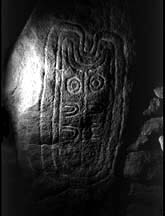
A “marking” on stone, Carnac. Photograph by Stephen Miller.

Stephen Miller’s dramatic photos of Megaliths in the Carnac region of France capture a certain kind of spell over the whole area, hard to pin down, maybe like an echo remaining from a time we have no ‘memory’ of.

Miller writes Carnac: eleven rows of standing stones stretching for 12 kilometers. Date and origin, unknown. And for scores of miles in all directions, scattered throughout the forests, in the fields, in the midst of human settlement, the dolmens, menhirs, circles, and alignments of an unknown age before history.
Here and there, inside a dolmen, a carving on a wall stone. A torso or womb shape? Some emblematic, some, like the walls of Gavrinis, shamanic, and some like the first glimmer of pictographic writing.

Carnac: In Egypt there is a Karnak too, the ‘temple of the sun’. In India, there is Koranak, a temple of the sun, home of the universal calendrical stone featured on the old Indian 10 rupee note. And I remember that the spaceship in Gurdjieff’s enigmatic “Beelzebub’s Tales To His Grandson” was also named Karnak. Local mythologies surrounding the stones abound. These are said to walk to the water sometimes, those to move or dance under the moonlight. They are almost always associated with fertility and enchantment.

These black and white photos remind me very much of Ismo Luukkonen’s photos of Swedish standing stones, as I wrote about last February.

There is more on Carnac at Vicki Sherwood’s The Megaliths of Carnac.

(Thanks to wood s lot)

3 Comments »

by Marja-Leena

final preparations

12:37 pm in Art Exhibitions, Being an Artist, Finland, Estonia & Finno-Ugric, Recent Exhibitions by Marja-Leena

brochure.jpg

With my printworks finished and ready to hang on Wednesday morning, I had a day of deserved and much-needed rest yesterday. Today I am sorting through my notes, even my blog posts which are a proving to be a very useful archive, to put together the supplementary information for my exhibition. You can see that I am a list person!

1. The curriculum vitae has been updated and is ready to print. Must update the copy on this blog soon.

2. The all-important Artist’s Statement – I’m re-revising this everytime I look at it! I’m starting with this early statement and adding some words by Kivikäs on the “silent message of man”. Because I’m including the last ten pieces of the Nexus series that preceded the current series, I need to say something about their connection.

3. I’m going to put up the five of Karen D’Amico’s original photos that I have used for the series of prints called Silent Messengers: Connecting with D’Amico along with a note about this collaboration-of-sorts.

4. I’m seriously thinking of displaying my copy of the 2003 Finno-Ugric Calendar with a print-out of the excellent introduction by Väinö Poikalainen along with some comments on the influence of Loit Joekalda on my work.

5. A short note of explanation regarding the strange title is underway for Nexus: Vyg and Willendorf to be put up next to that piece.

6. The colour brochures of my work (pictured above) that were printed to accompany the 2002 exhibition in Finland have been updated with a stick-on label with my new email and weblog addresses. Though the examples of work are older and not in this exhibition, the brochure is still an attractive “take-home” for visitors since I still have a couple of hundred of them as it was cheaper to print in large quantity.

4 Comments »

by Marja-Leena

Labour Day

9:01 pm in Canada and BC, Current Events by Marja-Leena

pots.jpg

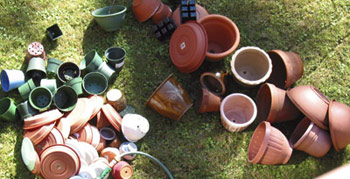
Today I was scrubbing out dirt and those squatters of damp and dark quarters – slugs, snails, sowbugs, spiders and worms. No, not an art project, rather a gardener’s chore. I finally tackled the huge annual task of washing all the plant pots which have been hidden under a tree by the compost, a job I always put off until I’m desperate for clean pots for repotting. For some time now I’d been saying to myself that I must repot some of my plants that have been summering outdoors, to ready them for re-entry indoors in a few weeks’ time, as well as start taking cuttings of geraniums and such. It was laborious but satisfying in the end. Tomorrow I hope to do some of the repotting.

It’s the end of the Labour Day long weekend here, with a lovely sunny day too. The damper cooler nights and long shadows signal the coming of fall. It’s the last weekend of summer in a way, as most schools in Canada begin tomorrow. But our weekend wasn’t all labouring or puttering around home. The highlight was a wonderful evening last night over dinner in a local little restaurant with dear friends who came back to their old neighbourhood for a few hours to see us (they retired to Victoria a couple of months ago).

On this day, I also looked up the history of Labour Day and was surprised to read about the Canadian roots of Labour Day. You might like to also check out about Labour Day in different countries at Wikipedia.

Comments Off on Labour Day

by Marja-Leena

Lascaux Caves replica

2:06 pm in Books, Rock Art & Archaeology by Marja-Leena

LascauxUnicorn.jpg
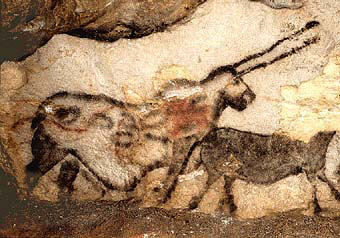
The Unicorn in the Great Hall of the Bulls, Lascaux Caves

A few days ago I picked up a gorgeous book from the library – Chauvet Cave: The Art of Earliest Times by Jean Clottes, and Paul G. Bahn (translator). I’ve visited the Chauvet Cave website before, so now I look forward to perusing the book, but haven’t yet had time to more than glance at the stunning pictures.

In a bit of synchronicity, I spotted an article and photo today in our local newspaper about another group of caves in the same region: Modern copy brings ancient art into view, originally from the Daily Telegraph, about the Lascaux Caves project.

A replica of the Lascaux caves, home to prehistoric man but out of bounds to his modern descendants, is to go on a world tour to take the art treasures to a wider public. A small team based near the caves in Motignac, south-west France, is creating the replica for an exhibition expected to visit several international cities, including London. Renaud Sanson, the team’s leader and one of the few people allowed inside the caves, said the use of laser techniques and photographic projection meant that the touring replica would be “better than the real thing”. The 17,000-year-old images are considered among the finest surviving examples of palaeolithic art and have been described as the Sistine Chapel of the prehistoric age.

An earlier post about the Lascaux project is at ionarts, translated from French papers and worth reading.

More interesting related links:
Lascaux II and area
Tour info
Pech Merle

I wonder how far we’d still have to travel to see these modern re-creations?

Comments Off on Lascaux Caves replica

by Marja-Leena

horoscope

12:02 am in Being an Artist by Marja-Leena

walking.jpg

“Going on a big journey means more to you than anything else right now. Don’t be too concerned with the spoils you could take home at the end of the day. Take time to appreciate what is simple and elegant. Clear your mind.”

I found this horoscope for Aquarius (that’s me) on May 19, 2002 in the daily newspaper that I was reading at the Vancouver airport while waiting to board a flight to Helsinki via Copenhagen. It was the start of an exciting trip for I was on my way to install an exhibition of my prints in Pohjanmaan Museum in Vaasa, Finland. (Read about that in a very early post.)

This horoscope was so very accurate and appropriate that I tucked it into my little travel diary with a frisson of synchronicity. I came across it just now when I went to find a certain forgotten name in that diary. Horoscopes, to me, are just amusements – rarely accurate and often aimed at young singles looking for a romantic partner. THIS one was a brilliant exception, don’t you think?

2 Comments »

← Previous Entries
Next Entries →

RECENTLY

  • New Year’s Eve 2016
  • Season’s Greetings
  • November already
  • this summer’s moth
  • Michiko Suzuki: Hope Chests
  • hand with Easter eggs
  • for Women’s Day

THEMES

  • Anthropology
  • Art Exhibitions
  • Art Institute (Printmaking)
  • Being an Artist
  • Blogging
  • Books
  • Canada and BC
  • Care of Art Works
  • Concepts
  • Culture
  • Current Events
  • Digital printmaking
  • Drawings
  • Environment
  • Ethnicity
  • Films
  • Finland, Estonia & Finno-Ugric
  • Folk Legends & Myths
  • History
  • Home
  • Linguistics
  • Modern Rock Art
  • Music
  • Neat stuff
  • Other artists
  • Photography
  • Print Triennials
  • Printmaking
  • Rock Art & Archaeology
  • Tools and technology
  • Travel

© Marja-Leena Rathje 2004-2026