Marja-Leena Rathje

on printworks and other passions
  • About
  • Gallery
  • Contact
  • Exhibitions
  • Home

PRINTWORKS

  • Hands
  • Fragments
  • Arkeo
  • Silent Messengers
  • Nexus
  • Paths
  • Meta-morphosis
  • Dreams
  • Veils Suite
  • Older Works

PHOTOWORKS

  • Found Objects
  • Human
  • Nature
  • Rocks
  • Textures
  • Urban

RSS Feeds

  • RSS - Posts

Blog

Search Results

Next Entries →
by Marja-Leena

writers and hoodoos

6:27 pm in Being an Artist, Folk Legends & Myths, Photoworks, Rock Art & Archaeology, Rocks by Marja-Leena

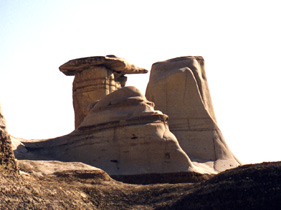
DrumhellerHoodoos.jpg
Hoodoos near Drumheller – photo by Marja-Leena

A few days ago I found Anita Konkka’s fascinating writer’s dairy. I quickly became absorbed reading the beautifully written entries, in a Finnish that I was able to understand and enjoy easily. (I’ve sometimes been frustrated not understanding today’s slang used by many Finnish bloggers.)

Anita Konkka is the author of many novels, essays, radio-plays, and a dream-book. Some of her novels address the question of Ingrian identity because of her father’s roots (the Ingrian Finns are from around St. Petersburg). Other novels are richly informed by dream studies and diverse cultural mythologies. An English translation of “In the Fool’s Paradise” is forthcoming (Dalkey Archive Press, 2006) which I will definitely look for in the North American market. I must try to get some of her Finnish books in the meantime! English readers will enjoy Anita’s excerpts of her writings at her literary website.

Attracted by her interest in dreams, myths and culture, including that of Russia, I emailed her and was very pleasantly surprised to receive a nice reply. Anita expressed fascination for the hoodoos in my “Silent Messengers” prints and had several good questions, which I think might interest my regular readers too.

What are hoodoos? These are geological formations of weathered rock in columnar or pillar forms and sometimes with caps. The Writing-on-Stone Provincial Park website has a good explanation as does Wikipedia.

Do the hoodoos have native petroglyphs or pictographs? “For hundred of years, the Blackfoot people visited this valley and believed that this amazing place was sacred and the home of spirits. Although it is rare for rock art to be found on hoodoos, there are both pictographs and petroglyphs upon the sandstone cliffs along the Milk River” in Writing on Stone Provincial Park. This is why I am still planning to visit these sites.

Is “hoodoo” an aboriginal word? This question stumped me as I’d not seen anything about its etymology. Googling found another writer, this time Canadian Bill Casselman, a broadcaster and the author of many books on Canadian words, sayings and names. He wrote an interesting story behind the word “hoodoo” and how it has nothing to do with “voodoo” as others have claimed. Here’s an excerpt:

“American aboriginal peoples of the northwest picked up the word hoodoo from English-speaking fur trappers and, like them, used hoodoo to refer to any malignant creature or evil supernatural force. That’s how it came to be applied to the curious columns of earth or rock. For they were thought to be evil in the mythologies of many first peoples. But, borrowing works in the other direction as well. For example, in Siksika (Blackfoot) mythology, the strange hoodooesque shapes were giants whom the Great Spirit had turned to stone because of their evil deeds. Deep in the night, the petrified giants could awaken and throw boulders down upon any humans passing nearby.”

No wonder hoodoos are such an attraction to artists and writers! Thanks to new virtual friend, Anita, for the great questions!

Comments Off on writers and hoodoos

by Marja-Leena

Duckomenta

12:06 am in Art Exhibitions by Marja-Leena

You must have a look at Die Duckomenta, an exhibition of works based on famous art works through the centuries, but with some very humorous adaptations! Perhaps you’ve already seen it, I’ve just rediscovered it in my bookmarks and felt like sharing the laughs! Just click on each “raum” (room) to see the works.

I had someone roughly translate the German for some information about the creators. They are a group of five artists who formed InterDuck in 1982, and share interests, in addition to their regular artistic pursuits, in ancient culture and in humour. InterDuck asks the question, which works the most important artists of the past have left for us, would they also have known and loved the comic characters. The art and the cultural history should probably be rewritten. We take our models seriously, we try to immerse ourselves in their work and thought process.  In our work, we not only approach close to the exterior facade, but also the soul and aura of these models. Since 1984 InterDuck has exhibited its continually growing collection of artworks in art associations and museums both at home and outside the country.  To date, over one million visitors have seen it. It is on exhibit presently at Museum Schloss Hohentübingen, Tubingen, Germany.

3 Comments »

by Marja-Leena

Holman’s Graphic Art

12:05 am in Culture, Other artists, Printmaking by Marja-Leena

Okheena42.jpg
Shaman Dances to Northern Lights 1991
Mary K. Okheena
stencil on paper, PWP 1/3 56.3 x 76.1 cm
Collection of The Winnipeg Art Gallery

I’ve been exploring this site with much pleasure: Holman: Forty Years of Graphic Art. Holman is a community located in Arctic Canada that is well-known for its graphic art. The site is based on an exhibition in 2002 of that name at the Winnipeg Art Gallery in Winnipeg, Canada, home to the largest collection of contemporary Inuit art in the Western world. (Back when I was living in Winnipeg in my youth, I saw several Inuit art exhibitions there.)

This excellent site features extensive information about life in Holman. A growing population in Holman and the demise of trapping as a source of income were key factors in the development of the arts and crafts industry. Drawing, printmaking, sculpture, and crafts provide an income for Holman artists. Read about the history of printmaking in Holman and the short biographies of the featured print artists. Note the useful descriptions of printmaking techniques along with the fascinating short videos of some of the artists demonstrating their techniques. Of course, the highlight is the gallery of works. Finally, don’t miss reading the wonderful story of The Blind Boy and the Loon, as an example of their story-telling tradition.

(Thanks to Print Australia, or now called bellebyrd for this great link.)

4 Comments »

by Marja-Leena

winter story 2006

1:25 pm in Being an Artist, Culture, Neat stuff by Marja-Leena

winterstory2006.jpg

I’m very proud to share my grand-daughter Lael’s 4th annual Winter Story, done with a little help from mommy and daddy, of course. It’s now on a special blog so you can see the past winter stories as well, should you be a new reader. Enjoy!

Our family will soon be gathering together in our home. We will have our Christmas Eve feast followed by carolling by the piano while we await Santa’s arrival. He always comes to the homes of Finns and Germans first, you know.
Merry Christmas everyone! Iloista Joulua kaikille!

10 Comments »

Next Entries →

RECENTLY

  • New Year’s Eve 2016
  • Season’s Greetings
  • November already
  • this summer’s moth
  • Michiko Suzuki: Hope Chests
  • hand with Easter eggs
  • for Women’s Day

THEMES

  • Anthropology
  • Art Exhibitions
  • Art Institute (Printmaking)
  • Being an Artist
  • Blogging
  • Books
  • Canada and BC
  • Care of Art Works
  • Concepts
  • Culture
  • Current Events
  • Digital printmaking
  • Drawings
  • Environment
  • Ethnicity
  • Films
  • Finland, Estonia & Finno-Ugric
  • Folk Legends & Myths
  • History
  • Home
  • Linguistics
  • Modern Rock Art
  • Music
  • Neat stuff
  • Other artists
  • Photography
  • Print Triennials
  • Printmaking
  • Rock Art & Archaeology
  • Tools and technology
  • Travel

© Marja-Leena Rathje 2004-2026